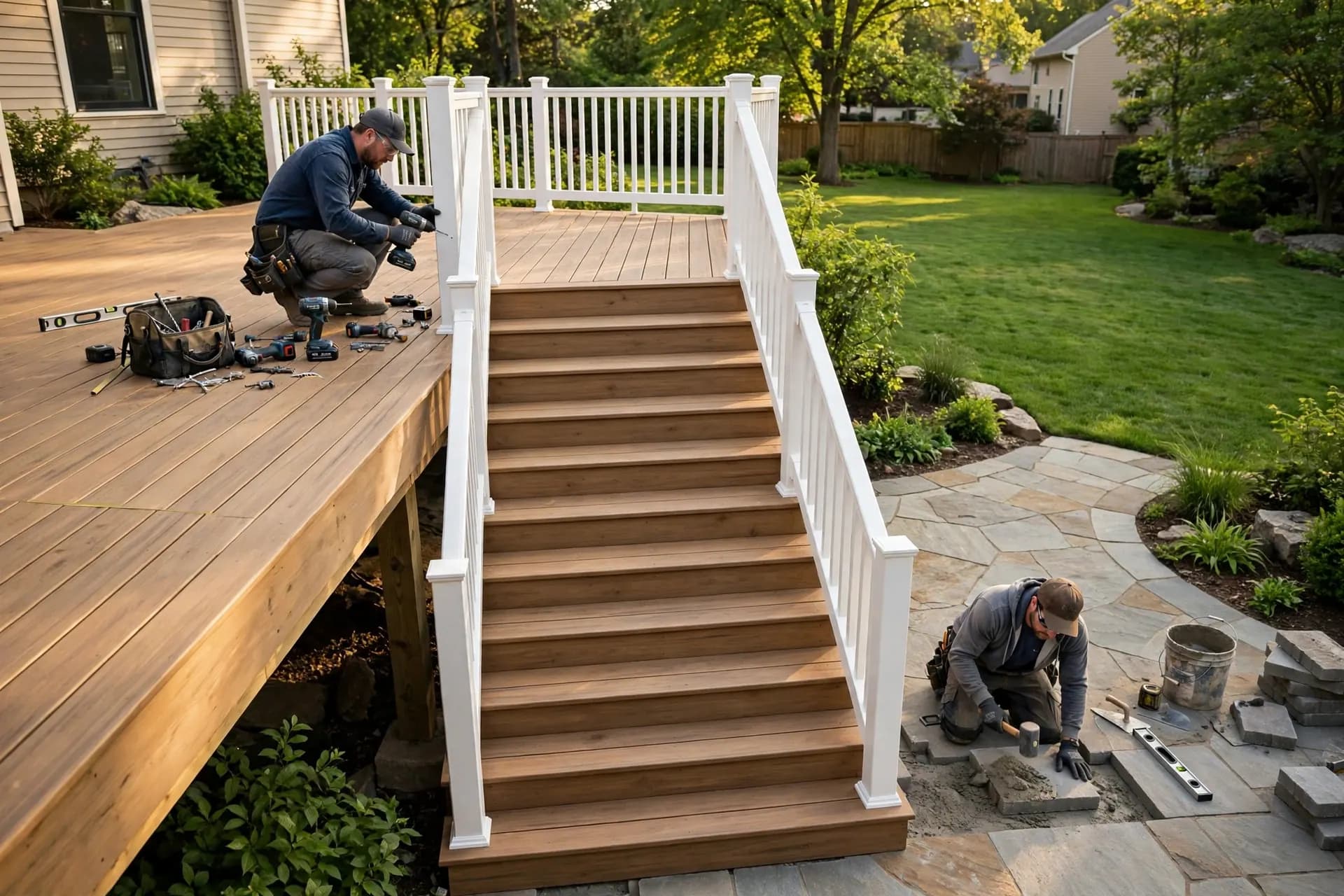
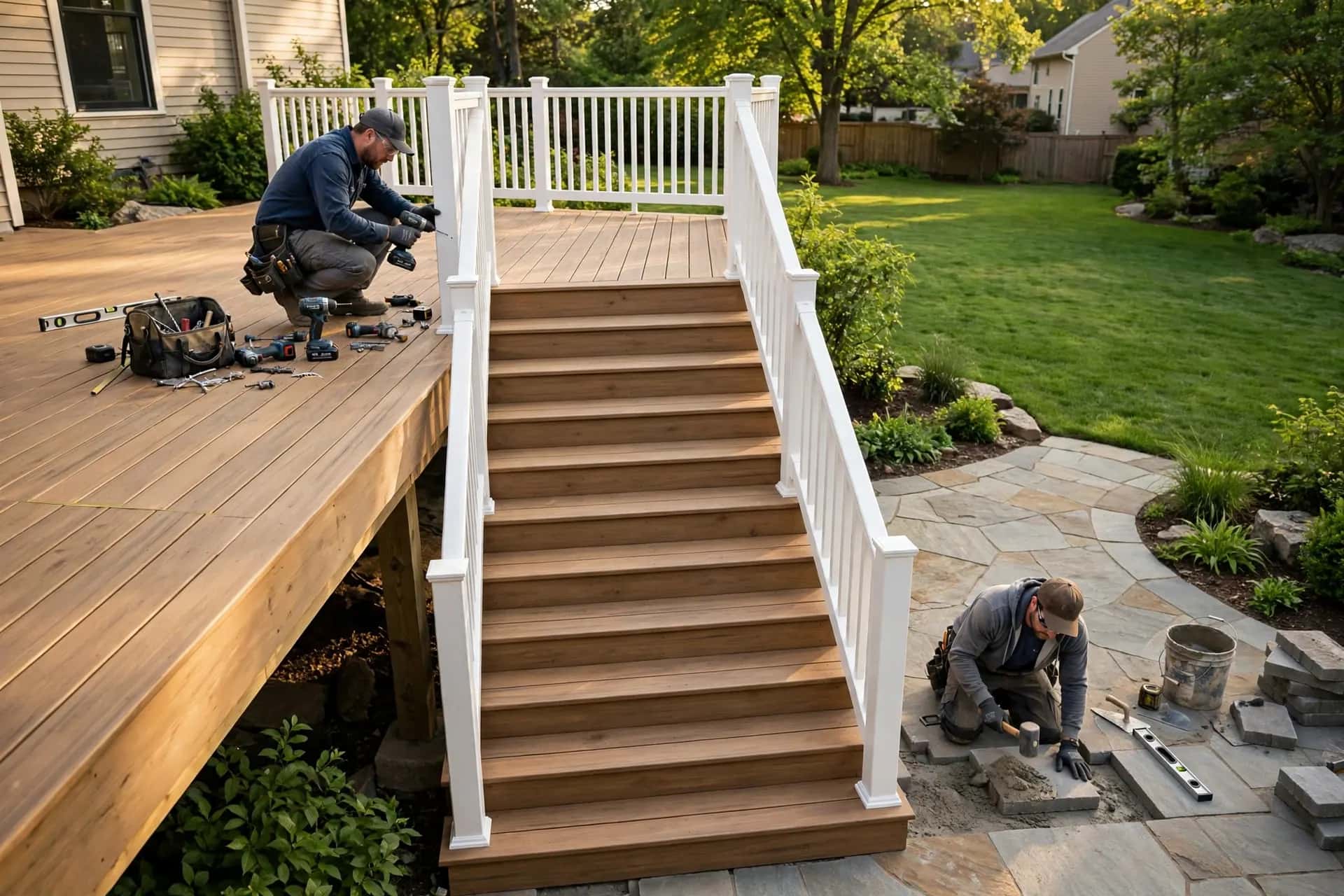
What are the warning signs of unsafe deck stairs?
Stringers that are cracked, soft or pulling away from the deck; treads that flex, split or rock; a landing that has sunk so the last step is taller; and handrails that move when grabbed.
Stringers — the notched boards that carry the treads — are the critical members. Notching removes much of a board's depth, and where the bottom of a stringer sits on soil or a damp pad, rot starts quickly. Check where the stringers meet the deck frame too: many older stairs hang from a few nails rather than hangers or bolts.
Why do uneven steps matter so much?
People expect each step to be the same height. Even a small difference — often at the top or bottom step after a landing settles — is a leading cause of trips. Model codes limit how much risers and treads may vary within a flight.
The IRC sets a maximum riser height of 7¾ inches and a minimum tread depth of 10 inches, with only a small variation allowed between steps. If a sunken landing has made the bottom step noticeably taller, the fix is usually to rebuild or raise the landing rather than add a shim step.
How are deck stairs repaired?
| Issue | Repair |
|---|---|
| Rotted stringer ends | Replace stringers; set them on a concrete pad or landing that drains, not on soil |
| Stringers loose at the top | Re-attach with stair hangers or a properly fastened ledger/rim connection |
| Bouncy treads | Add a middle stringer — composite treads usually need closer stringer spacing |
| Split or worn treads | Replace treads, keeping nosings consistent |
| Sunken landing | Rebuild the pad on compacted base so every riser matches |
| Loose handrail | Re-anchor posts and brackets; confirm the rail is graspable and continuous |
Should deck stairs be repaired or rebuilt?
Rebuild when more than one stringer is damaged, when the rise and run don't work, or when you're changing the layout — for example adding a landing or widening the stairs.
A rebuild lets you re-measure the total rise, divide it into equal steps, add a proper landing and design handrails from the start. It is also the time to add step lighting, which makes evening use safer.
How do you keep deck stairs safe in winter and wet weather?
- Choose textured treads and keep them clear of leaves and algae.
- Make sure water drains away from the landing rather than pooling at the bottom step.
- Use only ice-melt products your decking manufacturer allows, and plastic-bladed shovels.
- Add lighting at the top, bottom and on treads for dark evenings.
What makes a good landing at the bottom of deck stairs?
A firm, level, well-drained surface at least as wide as the stairs, such as a concrete pad or compacted-base pavers, that won't settle or hold water.
Landings are where stair problems often start. When stringers bear on soil or loose gravel, the landing sinks unevenly, the bottom riser grows taller and the stringer ends stay wet. A properly built pad keeps the bottom step the same height as the others, gives stringers a dry bearing surface, and makes it easy to step off the stairs onto a path or patio.
Can wood stairs be re-treaded with composite?
Often, but composite stair treads usually require closer stringer spacing than the main deck — commonly closer than many wood stairs were built with — so an extra stringer is frequently needed.
Check the decking manufacturer's stair requirements before ordering. Matching riser boards and fascia complete the look and protect the stringers from weather.
How does deck stair repair differ across the states we serve?
Snow, ice and shoveling are hard on stair treads and landings. The figure varies most between Minnesota (50) and Georgia (1).
| State | Snowfall, in / yr (median) | What it means |
|---|---|---|
| Georgia | 1 | Light snow: occasional ice is the main winter concern for deck stair repair |
| Illinois | 38 | Moderate snow: plan winter use and ice-melt for deck stair repair |
| Kansas | 14 | Light snow: occasional ice is the main winter concern for deck stair repair |
| Maryland | 29 | Moderate snow: plan winter use and ice-melt for deck stair repair |
| Massachusetts | 49 | Heavy snow: load, shoveling and ice drive deck stair repair |
| Minnesota | 50 | Heavy snow: load, shoveling and ice drive deck stair repair |
| North Carolina | 3 | Light snow: occasional ice is the main winter concern for deck stair repair |
| Pennsylvania | 22 | Moderate snow: plan winter use and ice-melt for deck stair repair |
| Tennessee | 3 | Light snow: occasional ice is the main winter concern for deck stair repair |
| Virginia | 19 | Moderate snow: plan winter use and ice-melt for deck stair repair |
| Washington | 4 | Light snow: occasional ice is the main winter concern for deck stair repair |
Figures are medians across our covered communities in each state, from NOAA 1991–2020 climate normals and the Census Bureau's 2020–2024 American Community Survey. Each state and community page explains local conditions in more detail.