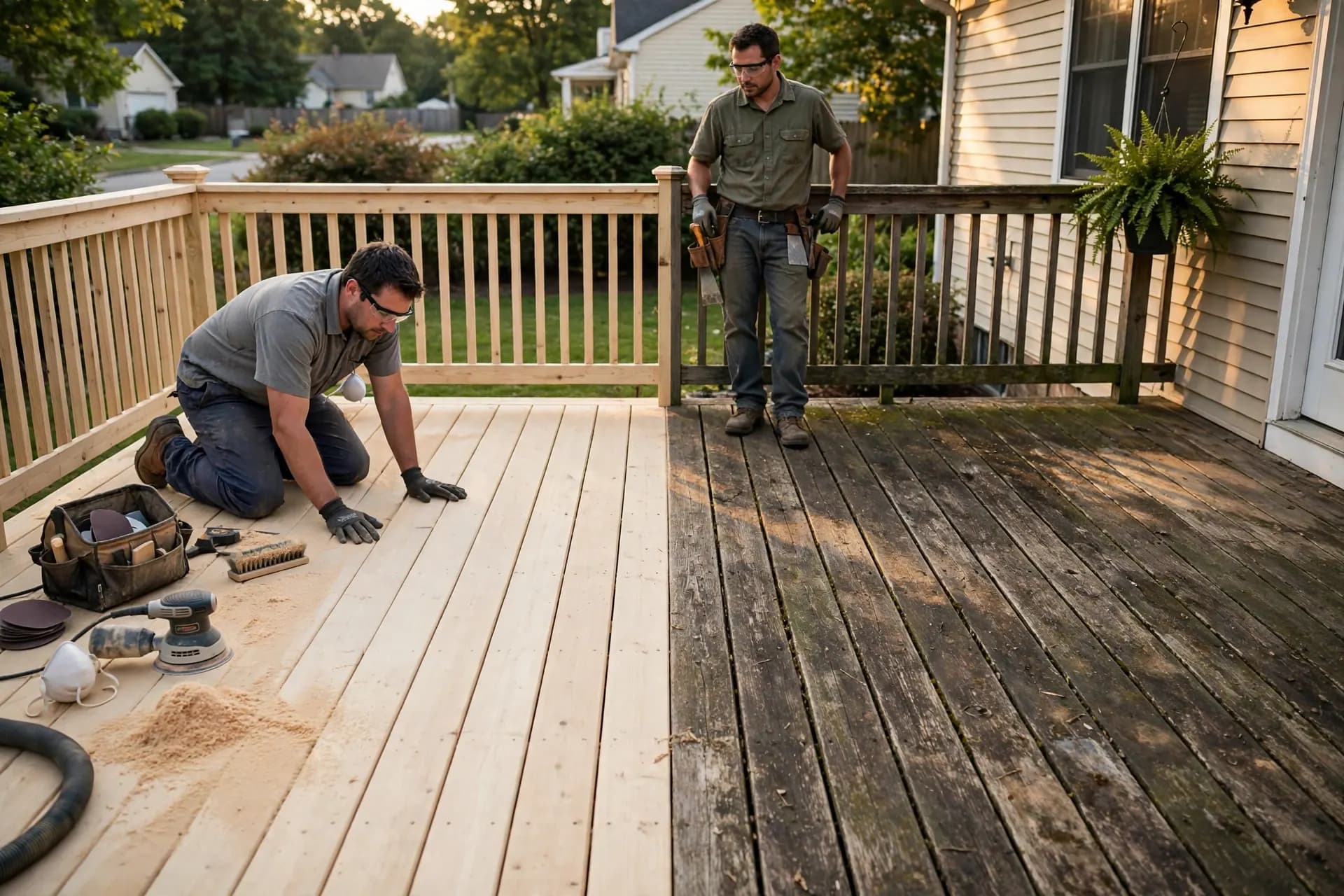
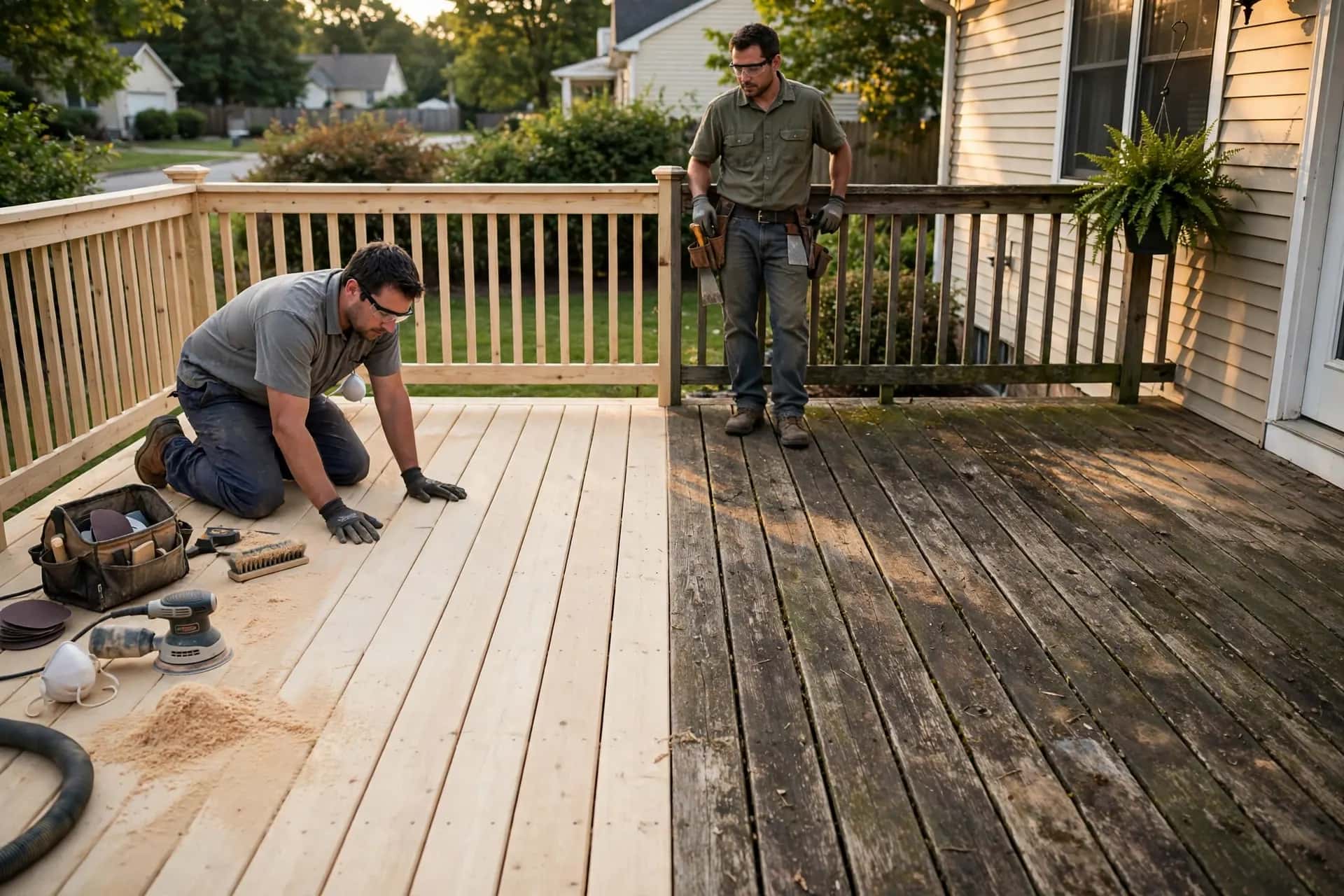
When does a deck board need to be replaced?
Replace a board when it is soft or spongy, cracked through, split along its length near fasteners, badly cupped, or missing chunks. Surface checking, graying and minor splinters can usually be fixed by cleaning, sanding and sealing instead.
- Soft spots that give under a heel or let a screwdriver sink in — a sign of rot.
- Splits that run through the board or radiate from fasteners, where the board can no longer hold a screw.
- Cupping or warping that creates a trip hazard or traps water.
- Broken or missing sections at board ends, stair nosings or around posts.
- On composite, delamination, deep gouges or boards that have been heat-damaged by a grill.
One or two bad boards on a deck that is otherwise in good shape are a classic repair. When boards are failing across the whole surface, the frame is usually old enough that resurfacing or replacement should be on the table instead.
Why check the joists before replacing deck boards?
Boards rot from the bottom up, where they sit on joists and trap moisture. If a board has rotted, the top of the joist under it often has too — and a new board fastened to a soft joist will not stay tight.
Once the damaged board is off, the joist tops are exposed. That is the moment to probe them, look for dark staining or soft fibers, and check that hangers and fasteners are intact. Minor surface damage can sometimes be treated and protected with joist tape; a joist that has lost real strength needs to be sistered or replaced before the new board goes on. Skipping this step is the most common reason a patched deck develops new soft spots within a few seasons.
Can new deck boards match the old ones?
Rarely perfectly at first. New wood is brighter than weathered wood, and composite colors change between product generations and fade slightly in sun. Planning where new boards go makes the difference far less noticeable.
| Decking | What to expect | Ways to reduce the contrast |
|---|---|---|
| Pressure-treated pine | New boards look green or bright; they weather toward gray over months | Clean and stain the whole deck once new boards are dry enough to accept finish |
| Cedar | New boards are reddish; old boards may be silver | Brighten and re-stain the full surface, or accept a natural blend |
| Composite | Discontinued colors may not be available; new boards may look slightly darker | Move sound boards from a hidden area to the visible spot and put new boards where they won't be noticed |
| PVC | Similar to composite; product lines change over time | Check the manufacturer's current color lineup and use matching trim |
How is a deck board replaced?
- 1Remove fasteners — screws are backed out; nails are pried or cut. Hidden-fastener systems may require removing boards from the nearest edge or using a manufacturer's replacement clip.
- 2Lift the board without damaging neighbors, and clear debris from the gaps.
- 3Inspect and repair the joist tops and any blocking beneath.
- 4Cut the new board so butt joints land over solid framing, keeping the deck's existing gap spacing.
- 5Fasten with corrosion-resistant screws or the decking manufacturer's specified clips, pre-drilling ends where needed.
- 6On wood decks, finish the new board — or the whole deck — once it is ready to accept stain.
Should you replace a few boards or re-deck the whole surface?
If more than about a quarter of the boards need attention, or most boards are checking and splintering, a full re-deck over a sound frame usually costs less per board and gives a uniform result.
Re-decking also lets you switch materials — for example from pine to capped composite — and correct problems like inconsistent gaps or boards that were installed bark-side down and are cupping. If you go that route, confirm the joist spacing works for the new boards; composite often needs closer spacing than the wood it replaces.
How does deck board replacement differ across the states we serve?
Board rot is driven by moisture. The figure varies most between Washington (95) and Minnesota (60).
| State | Wet days / yr (median) | What it means |
|---|---|---|
| Georgia | 80 | Frequent rain: flashing, drainage and airflow protect deck board replacement |
| Illinois | 74 | Drier spells: sun and checking are as important as moisture for deck board replacement |
| Kansas | 60 | Drier spells: sun and checking are as important as moisture for deck board replacement |
| Maryland | 81 | Frequent rain: flashing, drainage and airflow protect deck board replacement |
| Massachusetts | 82 | Frequent rain: flashing, drainage and airflow protect deck board replacement |
| Minnesota | 60 | Drier spells: sun and checking are as important as moisture for deck board replacement |
| North Carolina | 75 | Drier spells: sun and checking are as important as moisture for deck board replacement |
| Pennsylvania | 79 | Drier spells: sun and checking are as important as moisture for deck board replacement |
| Tennessee | 84 | Frequent rain: flashing, drainage and airflow protect deck board replacement |
| Virginia | 77 | Drier spells: sun and checking are as important as moisture for deck board replacement |
| Washington | 95 | Frequent rain: flashing, drainage and airflow protect deck board replacement |
Figures are medians across our covered communities in each state, from NOAA 1991–2020 climate normals and the Census Bureau's 2020–2024 American Community Survey. Each state and community page explains local conditions in more detail.