
38 eligible ZIP codes in Kansas
Deck builders in Kansas
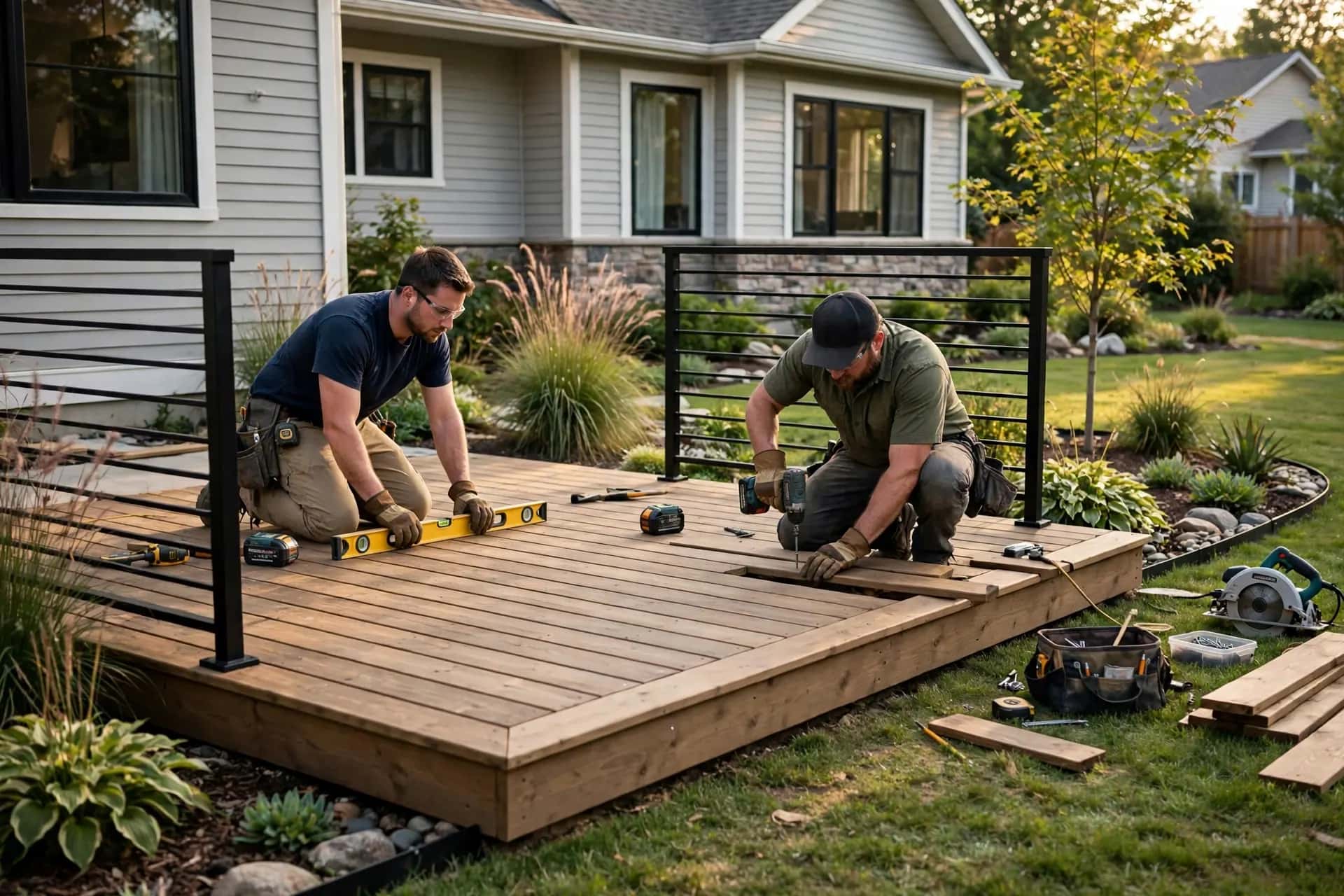
Deck building, replacement and repair in Johnson County and the Kansas City Metro — including Overland Park, Shawnee, Lenexa and Leawood. Coverage is limited to the ZIP codes listed below.
Regional guidance
Planning a deck in Kansas
Covered Kansas ZIPs are in the Kansas side of the Kansas City metro, chiefly Johnson County and nearby Miami County communities, with hot summers, cold winters, strong storms and wide temperature swings.
Temperature swings
Large seasonal and day-to-night swings make expansion gaps in composite and PVC especially important.
Storms and wind
Severe storms make solid post anchoring, lateral bracing and secure railings a priority.
Expansive soils
Some soils in the region shrink and swell with moisture, which affects footing design.
Seasonal planning
Spring and fall are popular for construction; summer projects are common but surface heat and storm delays should be planned for.
Materials for this climate
Composite and PVC work well when installed to the manufacturer's gap charts; wood should be sealed to handle sun and wet-dry cycles. Compare options in our materials guide.
Permits and building codes
Kansas does not enforce a single statewide residential building code; cities and counties adopt and enforce their own. Contact your city's building or permitting office. We don't publish local permit rules on this site because they vary and change — your building department is the authority.
Authoritative references
- Prescriptive Residential Wood Deck Construction Guide (DCA 6) — American Wood Council
- U.S. Climate Normals — NOAA National Centers for Environmental Information
How old is the housing in our Kansas service area?
Across our covered Kansas ZIP codes — about 273,367 homes — the median home was built around 1989, compared with 1976 for Kansas as a whole.
14% of homes in the covered area predate 1960, 22% were built in the 1960s and 1970s, 32% in the 1980s and 1990s, and 31% since 2000. The oldest housing is in Prairie Village (1957), Mission (1959) and Osawatomie (1961); the newest is in Stilwell (2002), Spring Hill (2002) and Gardner (2002). That spread is why deck projects here range from rebuilding retrofit decks on early-20th-century homes to upgrading decks on houses built in the last decade.
| Decade built | Homes | Share |
|---|---|---|
| 2020 or later | 7,117 | 3% |
| 2010s | 31,691 | 12% |
| 2000s | 46,651 | 17% |
| 1990s | 45,732 | 17% |
| 1980s | 42,369 | 15% |
| 1970s | 35,855 | 13% |
| 1960s | 24,690 | 9% |
| 1950s | 23,057 | 8% |
| 1940s | 7,104 | 3% |
| before 1940 | 9,101 | 3% |
What deck projects are most common in our Kansas service area?
Based on the age of our Kansas service area's housing, the largest group of projects is likely to be replacing or rebuilding aging decks.
- Replacement and major repair: about 123,956 homes (45%) were built between 1970 and 1999, the age group whose original or early add-on decks are most likely to have worn-out framing, connectors and boards.
- Retrofit decks on older homes: about 63,952 homes (23%) predate 1970. Here the priority is confirming that add-on decks are properly attached — or rebuilding them freestanding — before any cosmetic work.
- Upgrades and expansions: about 38,808 homes (14%) were built since 2010. Their decks are usually sound but small or builder-grade, so enlarging the deck, adding stairs and switching to composite or upgraded railings are common.
How much does climate vary across our Kansas service area?
Freezing days range from about 93 a year near Mission to about 128 near Shawnee, based on the nearest NOAA stations' 1991–2020 normals.
Average annual snowfall ranges from about 8.4 inches (Fontana) to 17.4 inches (Shawnee). Days with at least 0.1 inch of precipitation range from about 58 (Fontana) to 65 (Shawnee). Those differences change footing depth requirements, how often wood needs sealing and how much snow and moisture a deck must shrug off — so the right design for one Kansas community is not automatically right for another.
Which decking material is most popular for Kansas conditions?
Across our Kansas service area, capped composite is the strongest general fit because about 77 freeze-thaw days a year are hard on unsealed wood.
Composite and PVC work well when installed to the manufacturer's gap charts; wood should be sealed to handle sun and wet-dry cycles. Individual community pages explain how local housing age and the nearest weather station's data change that recommendation.
Which Kansas counties do you serve?
Covered Kansas ZIP codes fall in 2 counties: Johnson County and Miami County.
| County | Covered ZIPs | Communities |
|---|---|---|
| Johnson County | 32 | 12 |
| Miami County | 6 | 6 |
Exact coverage
Every covered Kansas city and ZIP code
Grouped by 3-digit ZIP prefix. Only the ZIP codes shown are eligible — neighboring ZIPs in the same city or town may not be.
ZIP prefix 660xx
- Bucyrus
66013
- De Soto
66018
- Edgerton
66021
- Fontana
66026
- Gardner
66030
- Louisburg
66053
- New Century
66031
- Olathe
66061, 66062
- Osawatomie
66064
- Paola
66071
- Spring Hill
66083
- Stilwell
66085
ZIP prefix 662xx
- Leawood
66206, 66209, 66211
- Lenexa
66215, 66219, 66220, 66227
- Mission
66202, 66205
- Overland Park
66204, 66207, 66210, 66212, 66213, 66214, 66221, 66223, 66224, 66251
- Prairie Village
66208
- Shawnee
66203, 66216, 66217, 66218, 66226
FAQs
Kansas deck questions
Do you build decks everywhere in Kansas?
No. We serve 38 specific ZIP codes in 18 Kansas communities, concentrated in Johnson County and the Kansas City Metro. Every covered ZIP is listed on this page.
Do I need a permit for a deck in Kansas?
Kansas does not enforce a single statewide residential building code; cities and counties adopt and enforce their own. Contact your city's building or permitting office. Confirm with the building department for your address before work begins.
What decking material works best in Kansas?
Composite and PVC work well when installed to the manufacturer's gap charts; wood should be sealed to handle sun and wet-dry cycles.
When is the best time to build a deck in Kansas?
Spring and fall are popular for construction; summer projects are common but surface heat and storm delays should be planned for.
How old are homes in your Kansas service area?
The median home across our covered Kansas ZIP codes was built around 1989 (Census ACS 2020–2024), versus 1976 statewide.
Kansas
Planning a deck in Kansas?
Call (888) 555-0123 to talk with a deck specialist about your project.