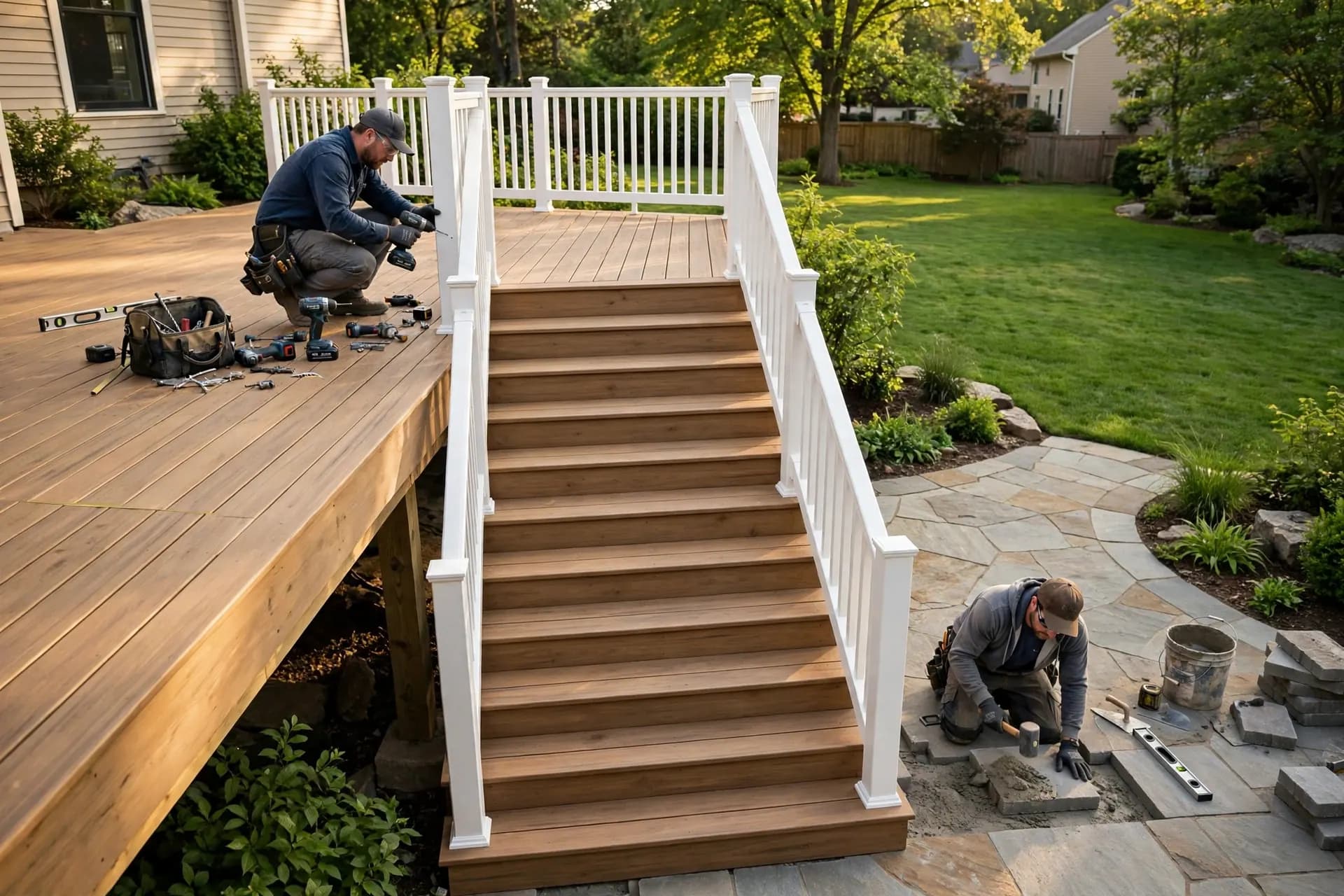
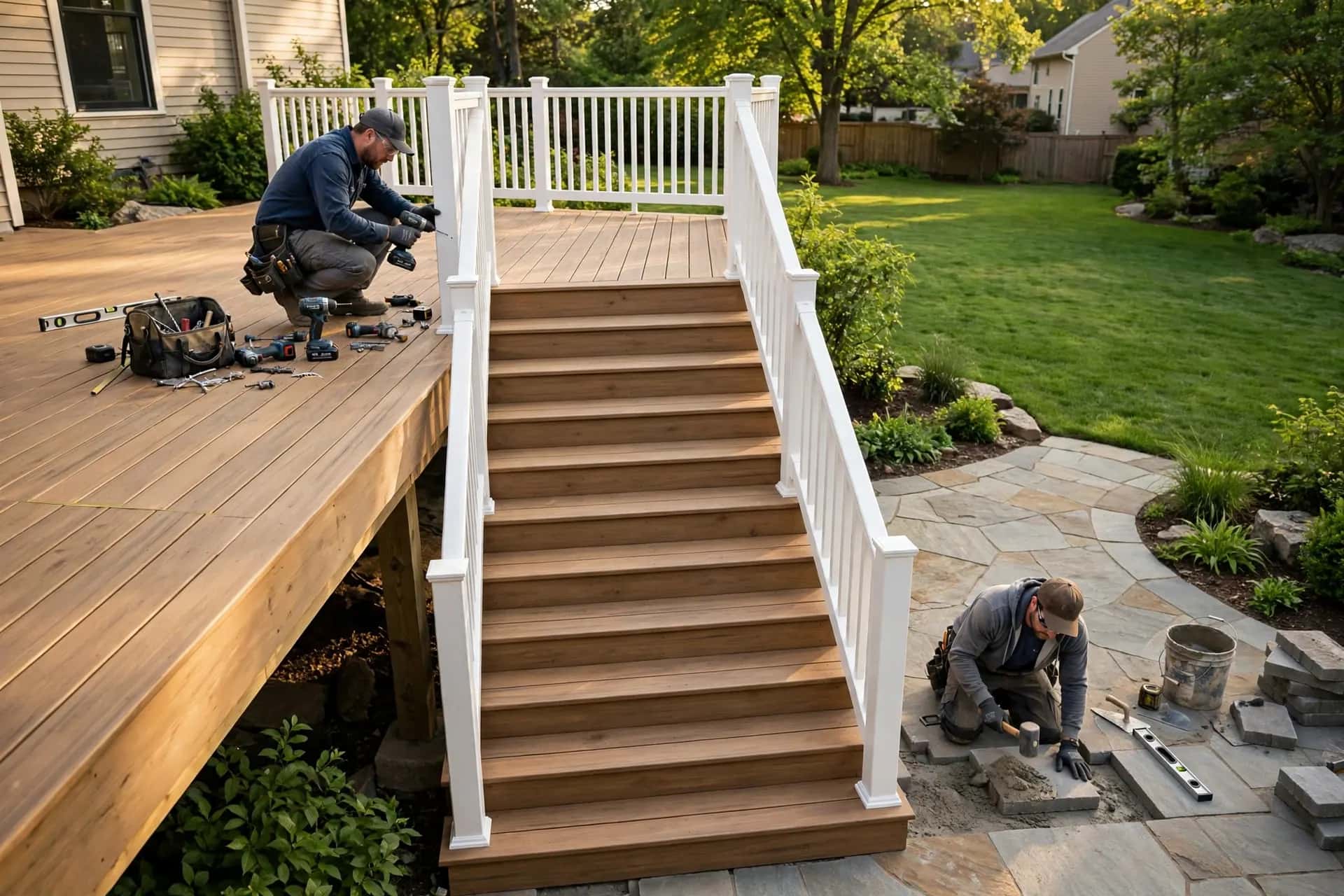
What makes deck stairs safe and comfortable?
Consistent step dimensions are the most important factor — uneven risers cause trips. Add solid stringers, a firm landing at the bottom, handrails and good lighting.
- Uniform riser height and tread depth from top to bottom.
- Stringers spaced closely enough for the tread material — composite treads often need tighter spacing.
- A stable landing pad at the bottom, not soil that will settle.
- Handrails that are easy to grip on at least one side, as required locally.
- Step or post lighting for evening use.
Stair layouts
| Layout | Best for |
|---|---|
| Straight run | Simple access where there's room in the yard |
| L-shaped with landing | Tall decks or tight yards; breaks up a long climb |
| Wide or wraparound steps | Low decks where the steps double as seating |
| Box steps | Ground-level decks with one or two steps |
Signs your deck stairs need repair
- Stringers that are cracked, rotted at the ground, or pulling away from the deck.
- Treads that flex, crack or rock.
- Handrails that move when grabbed.
- A bottom landing that has settled, creating a taller last step.
How wide should deck stairs be?
Minimum widths are set by code, but comfortable stairs are usually wider — wide enough for two people to pass or for carrying furniture and grill supplies.
Wide steps also become seating on low decks. On tall decks, a landing breaks up a long climb and can change the stair's direction to fit the yard.
What are the best materials for deck stairs?
| Part | Common choices |
|---|---|
| Stringers | Pressure-treated lumber rated for ground contact, or steel/aluminum stringers |
| Treads | Composite, PVC or wood; textured surfaces for traction |
| Risers | Matching boards or open risers where allowed |
| Landing | Concrete pad, pavers on compacted base, or a framed platform |
Should deck stairs have lighting?
Yes. Step or riser lights make edges visible at night, and a light at the top landing is often required for exterior stairs serving a door. Low-voltage LED systems can be wired during construction.
When should deck stairs be rebuilt?
If stringers are rotted, risers are uneven or the landing has sunk, rebuilding usually beats patching. See our deck stair repair guide for the warning signs.
How does deck stairs differ across the states we serve?
Snow and ice change stair design, tread choice and winter safety. The figure varies most between Minnesota (50) and Georgia (1).
| State | Snowfall, in / yr (median) | What it means |
|---|---|---|
| Georgia | 1 | Light snow: occasional ice is the main winter concern for deck stairs |
| Illinois | 38 | Moderate snow: plan winter use and ice-melt for deck stairs |
| Kansas | 14 | Light snow: occasional ice is the main winter concern for deck stairs |
| Maryland | 29 | Moderate snow: plan winter use and ice-melt for deck stairs |
| Massachusetts | 49 | Heavy snow: load, shoveling and ice drive deck stairs |
| Minnesota | 50 | Heavy snow: load, shoveling and ice drive deck stairs |
| North Carolina | 3 | Light snow: occasional ice is the main winter concern for deck stairs |
| Pennsylvania | 22 | Moderate snow: plan winter use and ice-melt for deck stairs |
| Tennessee | 3 | Light snow: occasional ice is the main winter concern for deck stairs |
| Virginia | 19 | Moderate snow: plan winter use and ice-melt for deck stairs |
| Washington | 4 | Light snow: occasional ice is the main winter concern for deck stairs |
Figures are medians across our covered communities in each state, from NOAA 1991–2020 climate normals and the Census Bureau's 2020–2024 American Community Survey. Each state and community page explains local conditions in more detail.