
How old are homes in Davidson County, and what does that mean for decks?
The median home in Davidson County was built in 1986; 18% predate 1960 and 35% were built since 2000.
Davidson County has about 357,113 homes, with a median construction year of 1986 (the Tennessee median is 1987). Within our covered ZIP codes — about 291,974 homes — the median is 1984, close to the county as a whole.
Homes in the covered parts of Davidson County have a median construction year of 1984, so a deck original to a typical house would now be about 42 years old — beyond the point where wood framing, fasteners and flashing can be assumed sound.
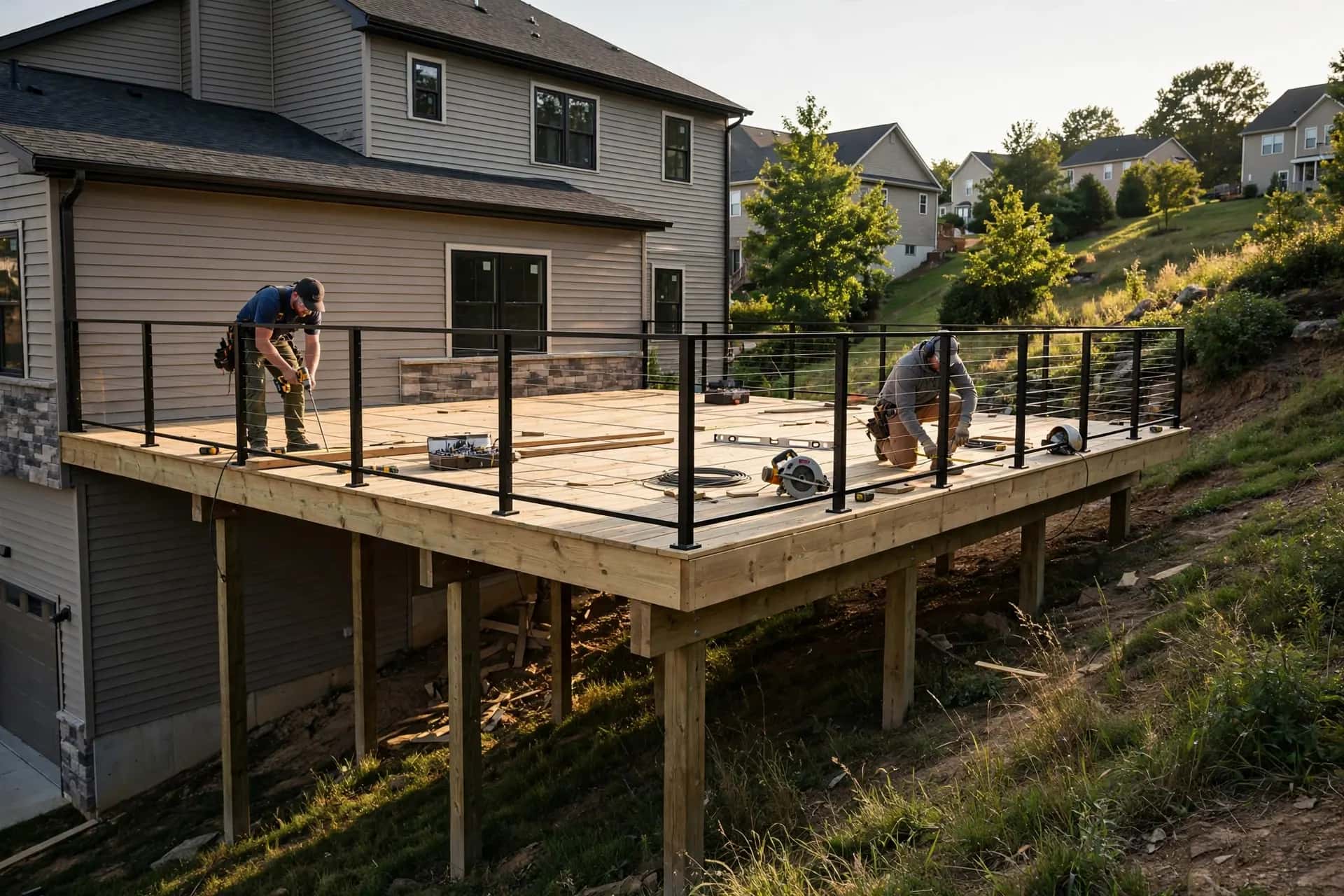
Many decks from the 1970s and 1980s were built before today's detailed deck provisions appeared in model codes. Common issues on decks of this age include corroded hangers, posts set directly in soil and ledger boards fastened with nails. Replacement is often the better value than repeated repairs.
| Decade built | Homes | Share |
|---|---|---|
| 2020 or later | 19,210 | 5% |
| 2010s | 57,158 | 16% |
| 2000s | 47,397 | 13% |
| 1990s | 36,967 | 10% |
| 1980s | 49,874 | 14% |
| 1970s | 44,212 | 12% |
| 1960s | 36,894 | 10% |
| 1950s | 31,876 | 9% |
| 1940s | 11,894 | 3% |
| before 1940 | 21,631 | 6% |
Which Davidson County communities have the oldest and newest homes?
Among covered Davidson County communities, Madison has the oldest housing (median 1977) and Antioch the newest (median 1996).
Oldest housing: Madison (1977), Nashville (1980) and Old Hickory (1983). In these communities, expect retrofit decks on older houses and aging decks that need structural inspection, ledger and flashing upgrades, or replacement. Newest housing: Antioch (1996), Hermitage (1991) and Goodlettsville (1988). Here, projects lean toward enlarging builder-installed decks, adding stairs and railings, and upgrading to low-maintenance boards.
How does Davidson County's climate affect deck building?
Covered parts of Davidson County average about 76 days a year at or below freezing (NOAA 1991–2020 normals, 5 stations). Across the covered communities, nearby stations range from about 68 to 91 freezing days a year, so conditions differ noticeably between Davidson County's higher, more rural areas and its urban core.
The nearest NOAA climate station with 1991–2020 normals is Shelby Bottoms Nature. It records an average of 76 days a year with a low at or below 32°F — a moderate number of freezing nights. On roughly 68 of those days the temperature climbs back above freezing, so water in wood, soil and gaps between boards repeatedly freezes and thaws.
Frost is less severe in Davidson County than in northern states, but footings still have to meet the local frost-depth requirement, and freeze-thaw cycles are enough to work loose nails and open checks in unsealed wood.
Snowfall is light — about 4.7 inches in an average year at Nashville Intl. AP — so occasional ice is a bigger concern than snow load. Textured boards and good drainage on stairs help on icy mornings.
Davidson County sees about 50.5 inches of precipitation a year, with measurable rain or snow (0.1 inch or more) on about 81 days. Good drainage between boards, clean gaps and a ledger that is properly flashed keep that water from rotting the frame.
Summers are hot: average summer highs are near 88°F, with about 51 days a year reaching 90°F or more. Surface temperature is a real consideration — lighter board colors, shade from the house or a pergola, and heat-mitigating composite lines are worth comparing.
What deck projects are most common in Davidson County?
Based on the age of Davidson County's housing, the largest group of projects is likely to be replacing or rebuilding aging decks.
- Replacement and major repair: about 131,053 homes (37%) were built between 1970 and 1999, the age group whose original or early add-on decks are most likely to have worn-out framing, connectors and boards.
- Retrofit decks on older homes: about 102,295 homes (29%) predate 1970. Here the priority is confirming that add-on decks are properly attached — or rebuilding them freestanding — before any cosmetic work.
- Upgrades and expansions: about 76,368 homes (21%) were built since 2010. Their decks are usually sound but small or builder-grade, so enlarging the deck, adding stairs and switching to composite or upgraded railings are common.
Which Davidson County communities do you serve?
6 communities in Davidson County have covered ZIP codes. Only the ZIPs listed are covered.
| Community | Covered ZIPs here | Median year built | Detached homes |
|---|---|---|---|
| Nashville | 37204, 37205, 37206, 37207, 37210, 37211, 37212, 37213, 37214, 37215, 37216, 37217, 37220, 37221, 37232 | 1980 | 53% |
| Antioch | 37013 | 1996 | 53% |
| Goodlettsville | 37072 | 1988 | 66% |
| Hermitage | 37076 | 1991 | 50% |
| Madison | 37115 | 1977 | 47% |
| Old Hickory | 37138 | 1983 | 77% |
What decking material works best in Davidson County?
Light-colored composite or pressure-treated wood is a strong default for Davidson County because about 51 days of 90°F+ heat make board color and surface temperature important.
49% of Davidson County's homes are detached single-family houses and 9% are townhouses or other attached homes; 53% of occupied homes are owner-occupied. With mostly detached homes, wood remains a practical lower-cost option for homeowners willing to clean and seal on schedule.
Who issues deck permits in Davidson County?
It depends on where you live: incorporated cities and towns in Davidson County usually run their own permit offices, while unincorporated areas are typically served by Davidson County.
Tennessee building code adoption and enforcement vary by local jurisdiction. Contact your city or county codes department. Before work starts, confirm with the building department for your exact address whether a permit is required, what drawings and inspections it involves, and whether an HOA must approve the design.