
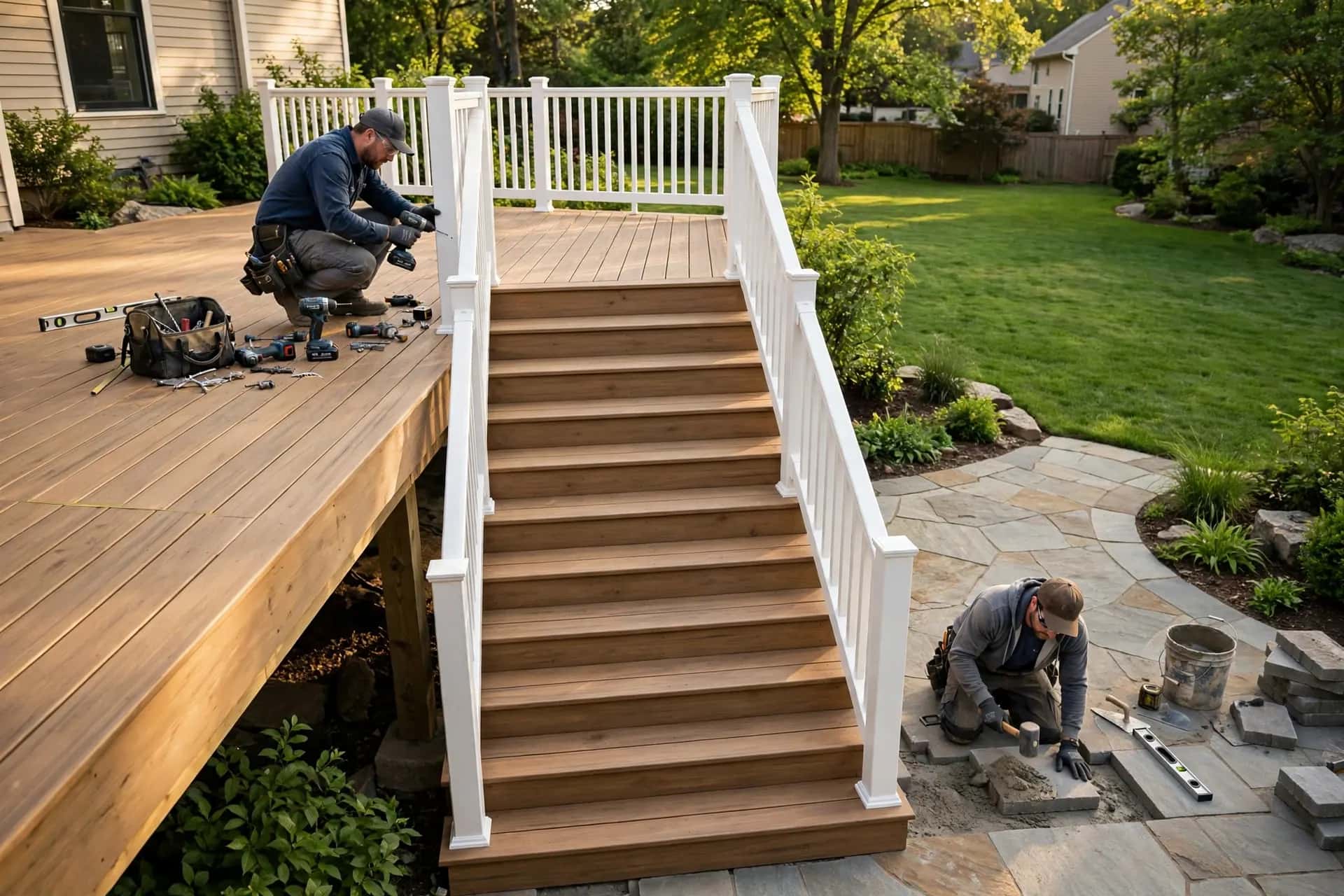
What does Hathorne's climate mean for deck construction?
Hathorne averages about 129 days a year at or below freezing, 47.8 inches of snow and 48.1 inches of precipitation, based on NOAA 1991–2020 normals.
The nearest NOAA climate station with 1991–2020 normals is Middleton, about 2 miles away. It records an average of 129 days a year with a low at or below 32°F — a substantial freezing season. On roughly 111 of those days the temperature climbs back above freezing, so water in wood, soil and gaps between boards repeatedly freezes and thaws.
For Hathorne, that means footings must bear below the locally required frost depth to avoid heaving, and wood surfaces should be kept sealed so absorbed water doesn't split boards over winter. Synthetic decking tolerates freeze-thaw well but still needs the manufacturer's expansion gaps.
Snow is a major factor: the Middleton station averages about 47.8 inches a year. Framing has to carry snow load, stairs need a plan for winter use, and snow removal should be done with plastic-bladed shovels and ice-melt products the decking manufacturer allows.
Hathorne sees about 48.1 inches of precipitation a year, with measurable rain or snow (0.1 inch or more) on about 85 days. Good drainage between boards, clean gaps and a ledger that is properly flashed keep that water from rotting the frame.
Average summer highs reach about 79°F, and around 16 days a year top 90°F. On a deck with full afternoon sun, dark composite can get uncomfortable on those days, so test samples in the sun before choosing a color.
Which decking material makes the most sense in Hathorne?
For most Hathorne homes, capped composite is the strongest starting point because about 111 freeze-thaw days a year are hard on unsealed wood and roughly 47.8 inches of snow a year means regular shoveling.
Budget, upkeep tolerance and sun exposure on your particular lot still decide the final choice between these options.
| Material | How it handles Hathorne's conditions |
|---|---|
| Pressure-treated pine | Economical; needs sealing to resist freeze-thaw splitting |
| Cedar | Attractive and stable; refinish to keep its color |
| Capped composite | Low maintenance; handles moisture and freeze-thaw well |
| PVC | Lightest and most moisture-proof; premium price |
What is housing like in Essex County around Hathorne?
Hathorne's covered ZIP code don't have their own Census housing estimates; Essex County figures give more reliable context.
Across Essex County, the median home was built in 1960. 50% of the county's 329,776 homes predate 1960, 20% were built in the 1960s and 1970s, 18% in the 1980s and 1990s, and 13% since 2000. 50% are detached single-family homes and 63% of occupied homes are owner-occupied.
For a deck project near Hathorne, that county mix means you are as likely to be dealing with an aging deck that needs structural inspection before any resurfacing as with a new build. Ask your contractor to confirm the age and construction of your specific deck rather than relying on area averages.
When is the best time to plan a deck project in Hathorne?
Hathorne has a defined building season. Spring and early fall offer the most comfortable working weather; winter is a good time to settle the design and apply for permits. Stains and sealers generally need dry weather and moderate temperatures, so plan wood finishing for late spring or early fall.
Do you need a permit to build a deck in Hathorne?
Often, yes — especially for attached or elevated decks — but the rules are set locally. Check with the building department that serves your address: the municipality, or Essex County for unincorporated areas.
For Hathorne, MA, ask the permit office whether your deck needs a permit based on its size, height and attachment to the house, which drawings and inspections are required. Statewide code background for Massachusetts is on our state page; local rules change, so the building department remains the authority.
How does Hathorne compare with nearby covered areas?
Hathorne's covered ZIP code span about 0.1 square miles of land with roughly n/a homes.
| Area | Distance | Median year built | Covered ZIPs |
|---|---|---|---|
| Danvers | 1.9 mi | 1963 | 1 |
| Middleton | 2 mi | 1986 | 1 |
| Peabody | 3.6 mi | 1966 | 1 |
| Topsfield | 4.4 mi | 1969 | 1 |
| Lynnfield | 4.5 mi | 1965 | 1 |
| North Reading | 5.1 mi | 1975 | 1 |
Deck planning checklist for Hathorne homeowners
- Confirm your ZIP code is 01937, the covered Hathorne ZIP.
- Ask what footing depth your building department requires for frost.
- Plan stair location and snow storage so winter shoveling doesn't damage boards or railings.
- Probe the ledger, post bases and joist tops for soft wood before planning a resurface.
- Call 811 before any digging so utility lines are marked.