
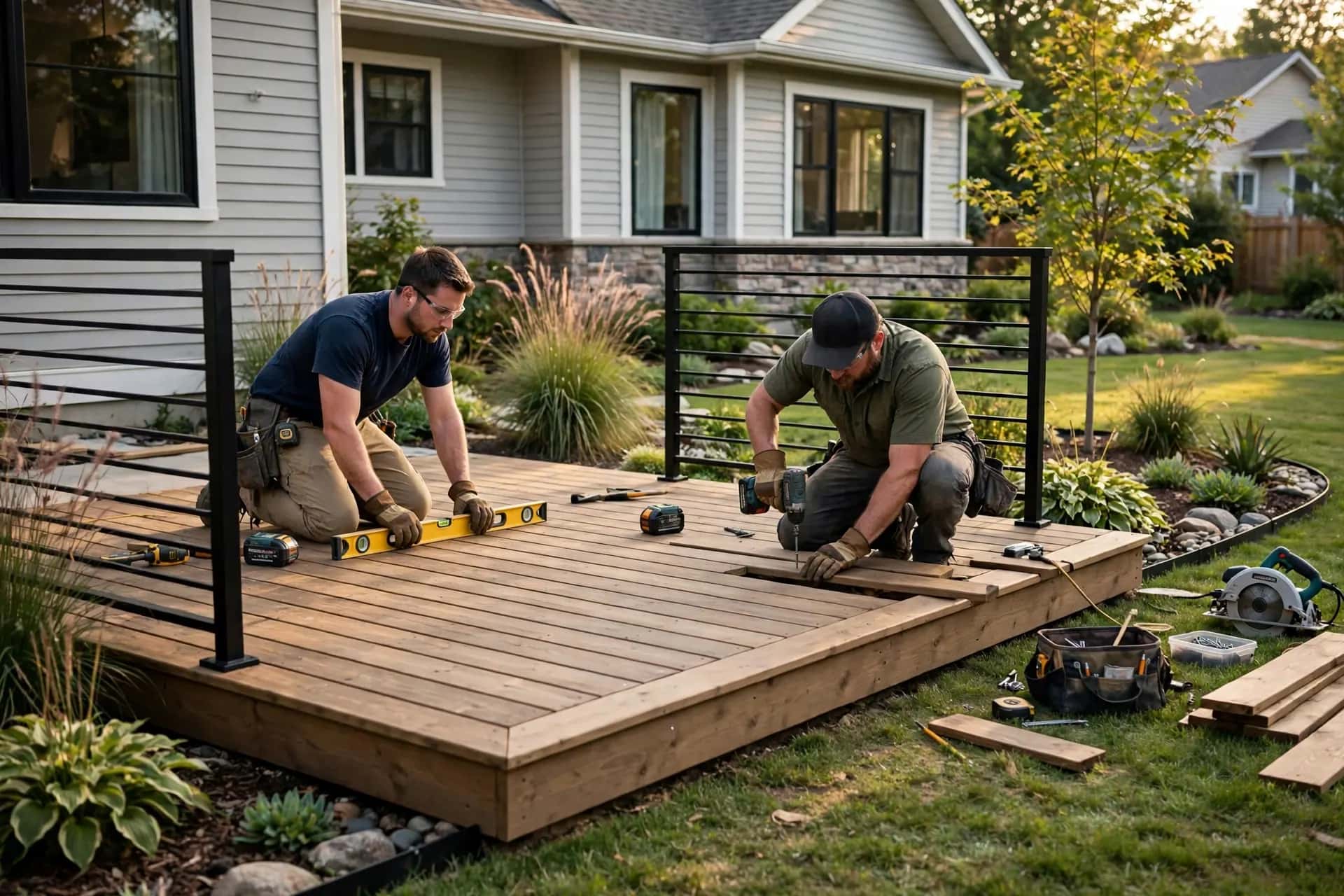
By Deck Building Services · Last reviewed
When does a deck need a railing?
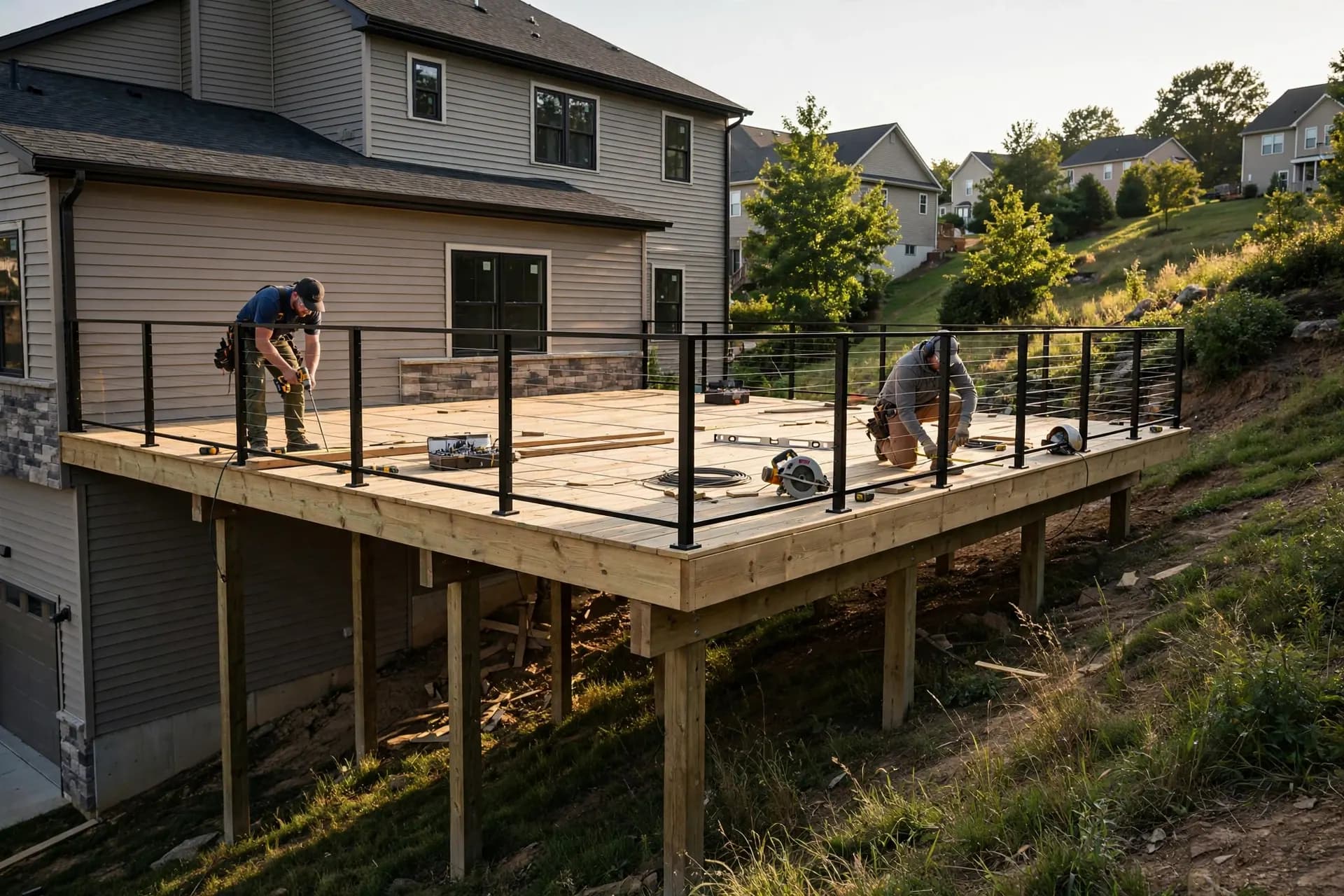
Under the IRC, guards are required on open sides of walking surfaces more than 30 inches above the floor or grade below, measured at any point within 36 inches horizontally of the edge.
That measurement is taken from the deck surface down to grade just beyond the edge — on a sloped yard, one side of a deck may need a guard while another doesn't. Many homeowners add railings to lower decks anyway for safety and appearance.
How tall must deck railings and handrails be?
| Element | IRC requirement | Notes |
|---|---|---|
| Deck guard height | At least 36 in. | Measured from the deck surface to the top of the guard |
| Stair guard height | At least 34 in. | Measured vertically from the stair nosings |
| Handrail height | 34–38 in. | Measured from the nosings; must be graspable |
| Guard openings | No 4-in. sphere passes | Stair guards allow 4-3/8 in.; stair-tread triangle allows 6 in. |
| Guard strength | 200 lb concentrated load | Applied at the top of the guard |
Why is post attachment the real safety issue?
A guard only meets the load requirement if its posts are anchored into the framing. Posts nailed or lagged to a single rim board often can't resist the required load, which is why modern details use blocking and through-bolts or tested hardware.
What are the rules for deck stair railings?
- Stairs with four or more risers generally need a handrail on at least one side.
- Handrails must be continuous for the full flight and graspable.
- Open sides of stairs above the 30-inch threshold also need guards.
- Stair guard openings are slightly larger (4-3/8 in.) under the IRC.
Do railing systems meet code automatically?
Manufactured aluminum, composite, cable and glass systems are typically tested as assemblies when installed exactly per their instructions — including post spacing and anchorage. Mixing components or changing post attachment can void that testing.
How does deck railing height and code requirements differ across the states we serve?
Elevated townhouse decks are where guard height and post anchoring matter most. The figure varies most between Virginia (23%) and Washington (5%).
| State | Attached homes (townhouses) | What it means |
|---|---|---|
| Georgia | 7% | Mostly detached homes: more freedom in deck railing height and code requirements |
| Illinois | 10% | Mostly detached homes: more freedom in deck railing height and code requirements |
| Kansas | 7% | Mostly detached homes: more freedom in deck railing height and code requirements |
| Maryland | 21% | Many townhouses: elevated rear decks and HOA rules shape deck railing height and code requirements |
| Massachusetts | 6% | Mostly detached homes: more freedom in deck railing height and code requirements |
| Minnesota | 11% | Mostly detached homes: more freedom in deck railing height and code requirements |
| North Carolina | 6% | Mostly detached homes: more freedom in deck railing height and code requirements |
| Pennsylvania | 19% | Mostly detached homes: more freedom in deck railing height and code requirements |
| Tennessee | 8% | Mostly detached homes: more freedom in deck railing height and code requirements |
| Virginia | 23% | Many townhouses: elevated rear decks and HOA rules shape deck railing height and code requirements |
| Washington | 5% | Mostly detached homes: more freedom in deck railing height and code requirements |
Figures are medians across our covered communities in each state, from NOAA 1991–2020 climate normals and the Census Bureau's 2020–2024 American Community Survey. Each state and community page explains local conditions in more detail.