
By Deck Building Services · Last reviewed
What does 16 inches on center mean?
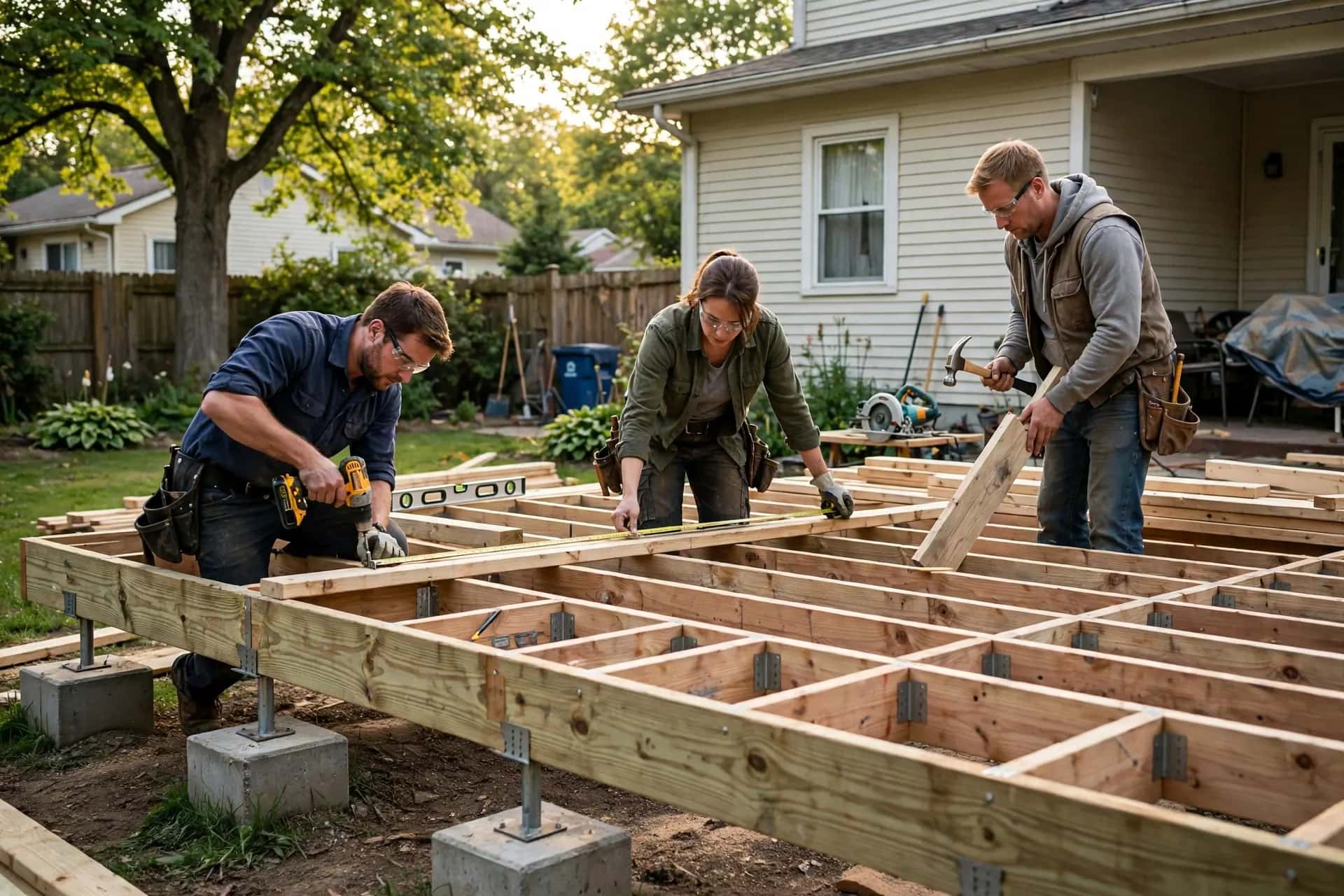
It's the distance from the center of one joist to the center of the next. Closer spacing means boards span a shorter distance and feel stiffer underfoot.
What joist spacing do different decking materials need?
| Decking | Straight layout | Diagonal (45°) | Stairs |
|---|---|---|---|
| 5/4 pressure-treated boards | 16 in. typical | Closer, often 12 in. | Closer than deck |
| 2x6 wood boards | Up to 24 in. in some guides | Closer | Per guide |
| Capped composite | Often 16 in. | Often 12 in. | Often closer still |
| PVC | Often 16 in. | Often 12 in. | Often closer still |
Can composite go on an old 24-inch frame?
Not without adding joists. Many older wood decks were framed wider than composite allows, so re-decking projects frequently add a joist between each existing pair.
How far can joists span?
Joist span — the distance between supports — depends on lumber size, species, grade, spacing and design load. Prescriptive tables such as those in the American Wood Council's DCA 6 list allowable spans; tighter spacing generally allows a longer span for the same joist size.
Why does joist flatness matter?
Synthetic boards follow the joists beneath them. Crowned or twisted joists create humps and dips that hidden fasteners can't hide. Good installers sight down joists, install them crown-up and plane or shim where needed.
What lumber is used for deck joists?
Most deck joists are pressure-treated softwood, commonly 2x8, 2x10 or 2x12, chosen by span. Many builders use lumber rated for ground contact because joists are hard to replace and often stay damp.
Steel and aluminum framing systems are alternatives that don't rot and stay straight, at a higher cost; they use their own fastening clips and span tables. Whatever the material, joists rest in rated hangers or on beams, and every hanger needs its full set of specified fasteners.
How do you protect deck joists from rot?
- Apply joist-top tape before decking goes on.
- Keep board gaps clear so water drains.
- Leave ventilation under low decks.
- Flash the ledger so water can't run behind it.
- Avoid trapping debris on top of joists at board seams.
Where does a deck need extra blocking?
- Under picture-frame borders and breaker boards.
- At board butt joints so both ends are supported.
- At railing post locations for anchorage.
- At mid-span on long joists to reduce bounce and twisting.
Why do diagonal decks need closer joists?
A board laid at 45 degrees spans a longer distance between joists than one laid straight across, so joists must be closer together to keep the same stiffness.
Herringbone and chevron patterns add blocking as well as closer spacing. Plan these layouts before framing, because adding joists afterward means taking boards back up.
How do you check joist spacing on an existing deck?
From underneath, measure from the center of one joist to the center of the next in several places. Note the joist size and the span between beams. Compare those with your chosen board's installation guide before ordering materials for a re-deck.