
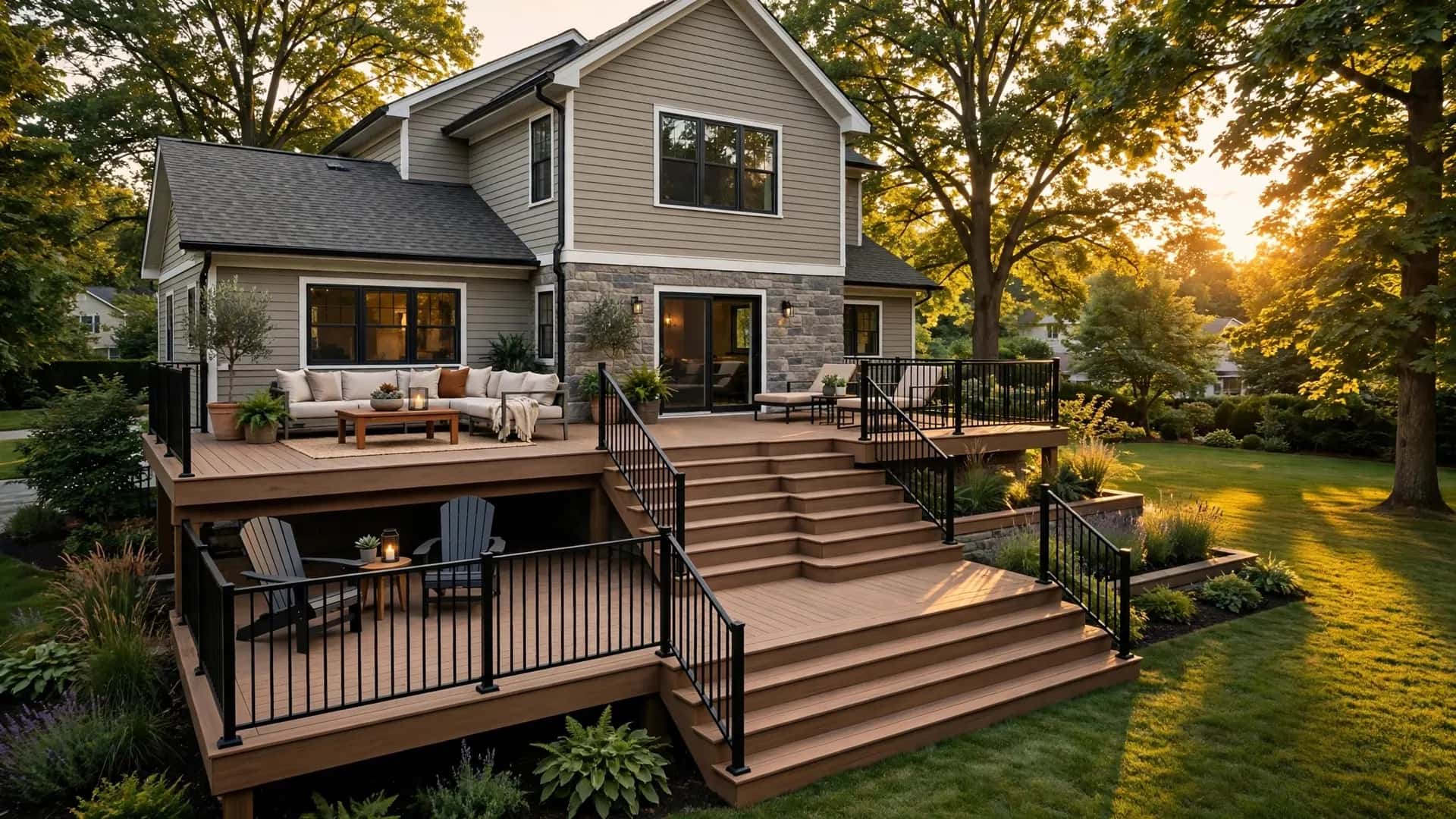
How old are homes in Dakota County, and what does that mean for decks?
The median home in Dakota County was built in 1988; 11% predate 1960 and 27% were built since 2000.
Dakota County has about 178,879 homes, with a median construction year of 1988 (the Minnesota median is 1979). Within our covered ZIP codes — about 179,382 homes — the median is 1988, close to the county as a whole.
Homes in the covered parts of Dakota County have a median construction year of 1988, so a deck original to a typical house would now be about 38 years old — beyond the point where wood framing, fasteners and flashing can be assumed sound.
Many decks from the 1970s and 1980s were built before today's detailed deck provisions appeared in model codes. Common issues on decks of this age include corroded hangers, posts set directly in soil and ledger boards fastened with nails. Replacement is often the better value than repeated repairs.
| Decade built | Homes | Share |
|---|---|---|
| 2020 or later | 4,242 | 2% |
| 2010s | 16,651 | 9% |
| 2000s | 27,801 | 16% |
| 1990s | 33,994 | 19% |
| 1980s | 34,042 | 19% |
| 1970s | 27,578 | 15% |
| 1960s | 14,834 | 8% |
| 1950s | 9,300 | 5% |
| 1940s | 3,200 | 2% |
| before 1940 | 7,237 | 4% |
Which Dakota County communities have the oldest and newest homes?
Among covered Dakota County communities, Mendota has the oldest housing (median 1953) and Lakeville the newest (median 2001).
Oldest housing: Mendota (1953), South Saint Paul (1958) and Vermillion (1972). In these communities, expect retrofit decks on older houses and aging decks that need structural inspection, ledger and flashing upgrades, or replacement. Newest housing: Lakeville (2001), Farmington (1997) and Rosemount (1996). Here, projects lean toward enlarging builder-installed decks, adding stairs and railings, and upgrading to low-maintenance boards.
How does Dakota County's climate affect deck building?
Covered parts of Dakota County average about 159 days a year at or below freezing (NOAA 1991–2020 normals, 5 stations). Across the covered communities, nearby stations range from about 146 to 159 freezing days a year, so conditions differ noticeably between Dakota County's higher, more rural areas and its urban core.
The nearest NOAA climate station with 1991–2020 normals is Rosemount Rsch & Outreach Ctr, about 2 miles away. It records an average of 159 days a year with a low at or below 32°F — a long, hard freezing season. On roughly 82 of those days the temperature climbs back above freezing, so water in wood, soil and gaps between boards repeatedly freezes and thaws.
For Dakota County, that means footings must bear below the locally required frost depth to avoid heaving, and wood surfaces should be kept sealed so absorbed water doesn't split boards over winter. Synthetic decking tolerates freeze-thaw well but still needs the manufacturer's expansion gaps.
Snow is a major factor: the Minneapolis/St Paul AP station averages about 51.2 inches a year. Framing has to carry snow load, stairs need a plan for winter use, and snow removal should be done with plastic-bladed shovels and ice-melt products the decking manufacturer allows.
Precipitation averages about 32.3 inches a year, falling on about 59 days with 0.1 inch or more — wet enough that drainage and flashing still matter, but dry spells also let wood surfaces dry out and check in the sun.
Summer heat is mild by comparison — average summer highs near 79°F and only about 8 days a year at 90°F or above — so board color can be chosen mostly on looks.
What deck projects are most common in Dakota County?
Based on the age of Dakota County's housing, the largest group of projects is likely to be replacing or rebuilding aging decks.
- Replacement and major repair: about 95,614 homes (53%) were built between 1970 and 1999, the age group whose original or early add-on decks are most likely to have worn-out framing, connectors and boards.
- Retrofit decks on older homes: about 34,571 homes (19%) predate 1970. Here the priority is confirming that add-on decks are properly attached — or rebuilding them freestanding — before any cosmetic work.
- Upgrades and expansions: about 20,893 homes (12%) were built since 2010. Their decks are usually sound but small or builder-grade, so enlarging the deck, adding stairs and switching to composite or upgraded railings are common.
Which Dakota County communities do you serve?
12 communities in Dakota County have covered ZIP codes. Only the ZIPs listed are covered.
| Community | Covered ZIPs here | Median year built | Detached homes |
|---|---|---|---|
| Saint Paul | 55118, 55120, 55121, 55122, 55123, 55124 | 1976 | 53% |
| Burnsville | 55306, 55337 | 1982 | 45% |
| Inver Grove Heights | 55076, 55077 | 1990 | 55% |
| Farmington | 55024 | 1997 | 72% |
| Hampton | 55031 | 1980 | 87% |
| Hastings | 55033 | 1983 | 66% |
| Lakeville | 55044 | 2001 | 75% |
| Mendota | 55150 | 1953 | 82% |
| Randolph | 55065 | 1976 | 95% |
| Rosemount | 55068 | 1996 | 70% |
| South Saint Paul | 55075 | 1958 | 67% |
| Vermillion | 55085 | 1972 | 89% |
What decking material works best in Dakota County?
Capped composite is a strong default for Dakota County because about 82 freeze-thaw days a year are hard on unsealed wood and roughly 51.2 inches of snow a year means regular shoveling.
58% of Dakota County's homes are detached single-family houses and 17% are townhouses or other attached homes; 75% of occupied homes are owner-occupied. The sizable townhouse share means many elevated rear decks where re-staining is awkward, which tilts the value toward composite or PVC.
Who issues deck permits in Dakota County?
It depends on where you live: incorporated cities and towns in Dakota County usually run their own permit offices, while unincorporated areas are typically served by Dakota County.
Minnesota has a statewide building code administered by the Department of Labor and Industry and enforced by municipalities that have adopted it. Before work starts, confirm with the building department for your exact address whether a permit is required, what drawings and inspections it involves, and whether an HOA must approve the design.