
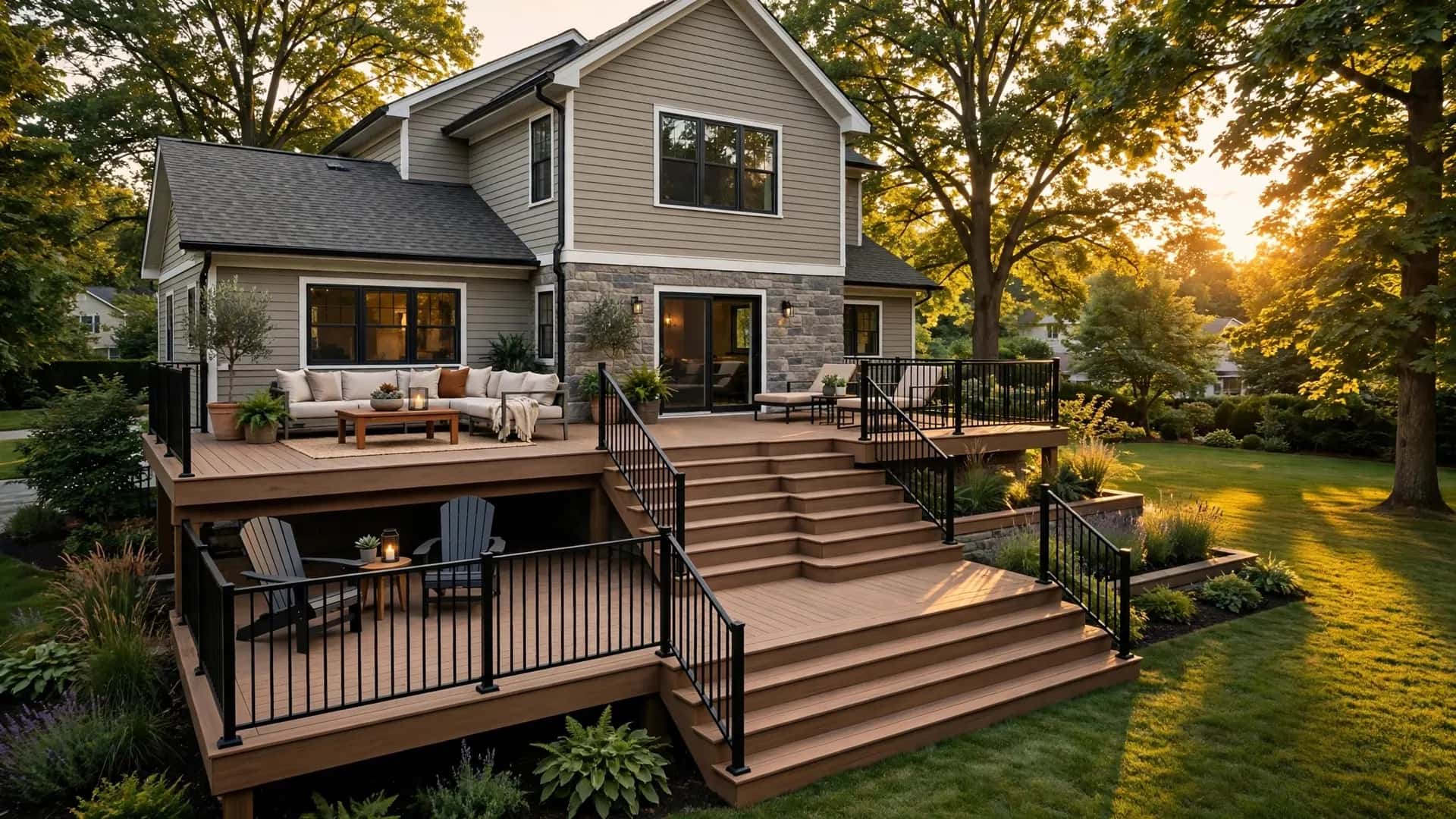
How old are homes in Carver, and what does that mean for a deck?
64% of homes in Carver's covered ZIP code were built in 2000 or later and 14% before 1960; the largest group dates to the 2000s.
Housing in Carver is relatively recent — the median home was built around 2005. Decks from this period are typically 19 to 21 years old: often structurally serviceable, but with weathered boards, loosening railings and finishes that need attention.
For decks of this age, resurfacing over a sound frame or upgrading railings can be good value. The frame should still be checked, because joist spacing on many builder-installed wood decks is too wide for composite boards without added joists.
That makes Carver's housing 9 years newer than Carver County as a whole, where the median home was built in 1996. Statewide, the median Minnesota home was built in 1979. Among the 62 covered Minnesota communities with Census data, Carver ranks #60 for oldest housing. In this ZIP code, 14% of homes were built before 1960, 7% between 1960 and 1979, 16% between 1980 and 1999, and 64% since 2000 — the single largest group dates to the 2000s.
| Decade built | Homes | Share |
|---|---|---|
| 2020 or later | 362 | 14% |
| 2010s | 528 | 21% |
| 2000s | 715 | 28% |
| 1990s | 277 | 11% |
| 1980s | 123 | 5% |
| 1970s | 70 | 3% |
| 1960s | 101 | 4% |
| 1950s | 140 | 6% |
| 1940s | 8 | 0% |
| before 1940 | 202 | 8% |
What does Carver's climate mean for deck construction?
Carver averages about 163 days a year at or below freezing, 39.8 inches of snow and 33.3 inches of precipitation, based on NOAA 1991–2020 normals.
The nearest NOAA climate station with 1991–2020 normals is Jordan 1ssw, about 5 miles away. It records an average of 163 days a year with a low at or below 32°F — a long, hard freezing season. On roughly 84 of those days the temperature climbs back above freezing, so water in wood, soil and gaps between boards repeatedly freezes and thaws.
For Carver, that means footings must bear below the locally required frost depth to avoid heaving, and wood surfaces should be kept sealed so absorbed water doesn't split boards over winter. Synthetic decking tolerates freeze-thaw well but still needs the manufacturer's expansion gaps.
Average snowfall near Carver is about 39.8 inches a year (Jordan 1ssw). That's enough that shoveling and ice-melt choices affect deck surfaces, and stair treads benefit from good texture and drainage.
Precipitation averages about 33.3 inches a year, falling on about 59 days with 0.1 inch or more — wet enough that drainage and flashing still matter, but dry spells also let wood surfaces dry out and check in the sun.
Summer heat is mild by comparison — average summer highs near 79°F and only about 6 days a year at 90°F or above — so board color can be chosen mostly on looks.
Which decking material makes the most sense in Carver?
For most Carver homes, capped composite is the strongest starting point because about 84 freeze-thaw days a year are hard on unsealed wood and roughly 39.8 inches of snow a year means regular shoveling.
Because so many Carver homes were built after 2000, matching the deck to vinyl or fiber-cement siding and existing trim colors is often part of the material decision.
| Material | How it handles Carver's conditions |
|---|---|
| Pressure-treated pine | Economical; needs sealing to resist freeze-thaw splitting |
| Cedar | Attractive and stable; refinish to keep its color |
| Capped composite | Low maintenance; handles moisture and freeze-thaw well |
| PVC | Lightest and most moisture-proof; premium price |
What kinds of homes are in Carver, and how does that shape deck design?
Carver has about 2,526 housing units across its covered ZIP code. 84% are single-family detached homes, 10% are attached homes such as townhouses and rowhouses, and about 6% are in buildings with two or more units. Roughly 94% of occupied homes are owner-occupied.
Detached single-family homes dominate in Carver, so most decks are backyard decks attached to the rear of the house. That gives more freedom on size, layout and stairs, and makes a well-planned deck one of the most-used rooms of the home.
What deck projects are most common in Carver?
Based on the age of Carver's housing, the largest group of projects is likely to be upgrading and enlarging newer decks.
- Upgrades and expansions: about 890 homes (35%) were built since 2010. Their decks are usually sound but small or builder-grade, so enlarging the deck, adding stairs and switching to composite or upgraded railings are common.
- Replacement and major repair: about 470 homes (19%) were built between 1970 and 1999, the age group whose original or early add-on decks are most likely to have worn-out framing, connectors and boards.
- Retrofit decks on older homes: about 451 homes (18%) predate 1970. Here the priority is confirming that add-on decks are properly attached — or rebuilding them freestanding — before any cosmetic work.
When is the best time to plan a deck project in Carver?
With about 163 freezing days a year, the building window in Carver is compressed. Design, drawings and permits are usually handled in winter so footings can go in as soon as the ground allows in spring, and finishes like stain are applied before nights turn cold in fall.
Do you need a permit to build a deck in Carver?
Often, yes — especially for attached or elevated decks — but the rules are set locally. Check with the building department that serves your address: the municipality, or Carver County for unincorporated areas.
For Carver, MN, ask the permit office whether your deck needs a permit based on its size, height and attachment to the house, which drawings and inspections are required. Statewide code background for Minnesota is on our state page; local rules change, so the building department remains the authority.
How does Carver compare with nearby covered areas?
The closest covered area is Cologne, about 6.1 miles from the center of Carver's covered ZIPs. Its median home was built in 1994, 11 years earlier than in Carver. Carver has 8 percentage points fewer detached single-family homes (84% vs. 92%), which changes how many projects are backyard decks versus compact townhouse decks. Owner-occupancy is 94% in Carver compared with 91% in Cologne. Carver's covered ZIP code span about 27.3 square miles of land with roughly 2,526 homes — about 93 per square mile, a low density that usually allows larger decks and freestanding designs.
| Area | Distance | Median year built | Covered ZIPs |
|---|---|---|---|
| Cologne | 6.1 mi | 1994 | 1 |
| Jordan | 6.5 mi | 1993 | 1 |
| Chaska | 7.2 mi | 1995 | 1 |
| Belle Plaine | 8.7 mi | 1996 | 1 |
| Shakopee | 9.1 mi | 1999 | 1 |
| Victoria | 9.9 mi | 2006 | 1 |
Deck planning checklist for Carver homeowners
- Confirm your ZIP code is 55315, the covered Carver ZIP.
- Ask what footing depth your building department requires for frost.
- Plan stair location and snow storage so winter shoveling doesn't damage boards or railings.
- Probe the ledger, post bases and joist tops for soft wood before planning a resurface.
- Call 811 before any digging so utility lines are marked.